
Reviewed · BANGKOK TUK-TUK TOURS
Experience Bangkok with typical Thai tuk-tuk
Tuk-tuks turn Bangkok into a fast, fun loop. In just 2 hours, this typical Thai tuk-tuk route strings together the city’s top landmarks, plus a few stops that give you real street-level Bangkok energy without spending the whole day in traffic.
I like two things most. First, you get a licensed English-speaking guide who talks you through what you’re seeing, so you’re not just bouncing from one photo spot to the next. Second, you stop often enough to reset, stretch your legs, and get great angles, including a folding lotus flower activity and photo-friendly landmarks like Sao Chingcha. The main drawback to plan for is that you will pay some admission on your own, since the Grand Palace ticket is not included, and with tuk-tuks on a shared basis (max two people per tuk-tuk), you may not stay together as one vehicle if your group is larger.
In This Review
- Key points to know before you ride
- The Bangkok Tuk-Tuk Route You Can Do Without Burning a Full Day
- Price and What You Actually Get for $28.70
- Stop-by-Stop: Grand Palace to Wat Pho in One Tight Loop
- Grand Palace: the big-ticket opener
- Sao Chingcha (Giant Swing): a classic photo landmark
- Wat Ratchanatdaram and Loha Prasat, the Metal Castle
- Chinatown, the Yaowarat Road area
- Pak Khlong Talat Flower Market: a 24/7 sensory change
- Wat Arun (Temple of Dawn): the river-view payoff
- Wat Pho and the Thai Traditional Massage School
- Guide Power: Why Names Like Anna, Enjoy, and Paul Keep Coming Up
- How to Get the Most From Short Stops (Without Feeling Rushed)
- Who This Tuk-Tuk Tour Fits Best
- Should You Book This Bangkok Tuk-Tuk Tour?
- FAQ
- How long is the tuk-tuk tour?
- What is included in the price?
- Are temple admission fees included?
- What is the maximum number of passengers per tuk-tuk?
- Where do you start and where does it end?
- Does the tour run in rain?
- How large are the groups?
- What should I do if I am late to the meeting point?
- Can I cancel for a full refund?
Key points to know before you ride
- Typical tuk-tuk ride, shared, max two passengers per tuk-tuk so it can mean splitting up for larger groups
- 2 hours with multiple short stops, built for orientation and photos, not a slow museum-style visit
- Grand Palace has its own admission ticket (15-minute stop), while several other key stops are free
- Chinatown and Pak Khlong Talat are included for the “everyday Bangkok” contrast to temple sights
- Wat Arun and Wat Pho round out the loop with classic river and temple views
- Guide quality seems to be the secret sauce, with strong praise for guides like Anna, Enjoy, Paul, Johann, Pu, Bella, and Ken
The Bangkok Tuk-Tuk Route You Can Do Without Burning a Full Day
This tour is a smart answer to a common Bangkok problem: the city is huge, and distances can eat your time. A typical Thai tuk-tuk ride is not just for thrills. It’s also a practical way to see a cluster of landmarks quickly, while a guide keeps the pace tight and the stops efficient.
The vibe is lively but not chaotic. The schedule is built around short blocks, so you can look around, snap photos, and move on before you feel worn out. One review praised the relaxed pacing even with lots packed in. Another called it an excellent intro when you only have a short layover window. That matches the structure here, where the entire experience is about 2 hours (approx.).
It also helps that the tour includes one bottle of drinking water. Bangkok heat and humidity can turn a “quick walk” into a slog, so that small inclusion matters, especially if you show up slightly underprepared.
One more thing I appreciate: this is not just “temples, temples, temples.” You get temple classics, then you shift into markets and Chinatown. That balance is the difference between a sightseeing checklist and an actual sense of place.
Price and What You Actually Get for $28.70
At $28.70 per person, you’re paying for four core values: a guide, the tuk-tuk transport, timed access to key places, and a few curated stops that you might skip if you’re solo.
Included in the price:
- Licensed English-speaking tour guide
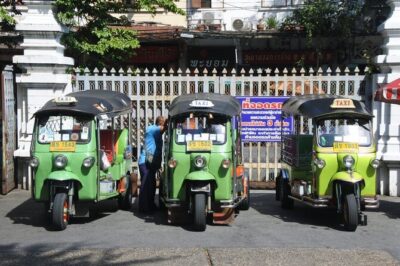
- Typical Thai tuk-tuk ride
- One bottle of drinking water
- Folding lotus flower activity
Not included:
- Personal expenses
- Gratuities for the tuk-tuk driver and guide (optional)
- Admission ticket for the Grand Palace (explicitly not included)
Here’s the honest math. If you’re only visiting temples on your own, you might spend money anyway on tuk-taxis, entrance tickets, and a guide. What you’re really buying is organization plus transport, so you spend less time figuring things out and more time seeing. The trade-off is short stop times, so you won’t get a deep, slow visit everywhere.
Also, since the tour is group-based and tuk-tuks are shared (max two passengers per tuk-tuk), you’ll want to accept that your comfort depends on the group configuration that day. For most people, that’s fine. For families or groups of three plus, it may feel like you are separated across multiple tuk-tuks.
Stop-by-Stop: Grand Palace to Wat Pho in One Tight Loop
The itinerary is designed like an intro circuit. Each stop has a purpose, and the time blocks keep you moving without feeling rushed into nothingness.
Grand Palace: the big-ticket opener
You start at the Grand Palace, with a 15-minute stop. This is the former home of the kings of the Chakri Dynasty, and the palace was built in 1782 under Rama I. The architecture is the point here, even if your time is limited.
Why it’s worth it: this is one of those places where seeing the scale and detail once helps the rest of Bangkok make more sense. Even if you don’t do a full, slow tour, the Grand Palace gives you an anchor for what comes after.
Practical drawback: admission is not included. So budget time and money for your own ticket at the start. In a short stop like this, you don’t want the admission process to eat your entire 15 minutes.
Sao Chingcha (Giant Swing): a classic photo landmark
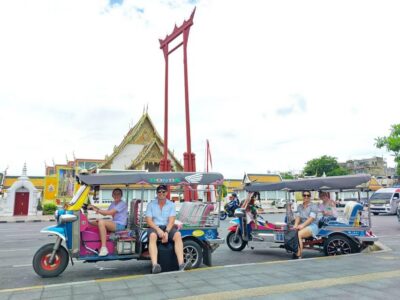
Next is Sao Chingcha, also known as the Giant Swing, another 15-minute stop and free to enter. It’s a religious structure tied to an older Brahmin ceremony.
This stop works because it’s instantly recognizable, even from a distance. One detail from the tour description that I like is that it’s framed as a landmark people want to photograph for family back home. If you want one “I was there” Bangkok image without hunting, this is it.
You also get a quick break from long temple walks. It’s easier to treat this like a short pause, get a few photos, and reset before the next site.
Wat Ratchanatdaram and Loha Prasat, the Metal Castle
Stop three is Wat Ratchanatdaram Worawihan and Loha Prasat, known as the Metal Castle, also 15 minutes and free. It was built in 1846 under King Rama III, and it draws inspiration from similar temples in India and Sri Lanka.
This is a great stop if you like visual details. Even in a short visit, Loha Prasat gives you something different from the usual gold and spire templates, which helps the whole day avoid feeling repetitive. The tour also positions it as part of the temple complex route, so it flows logically after Sao Chingcha.
Potential drawback: if you’re someone who expects a long temple exploration, this will feel like a quick glance. But as a 2-hour introduction, it hits the right notes.
Chinatown, the Yaowarat Road area
Then you head into Chinatown, with 20 minutes and free entry. This is one of the largest Chinatowns in the world, and it’s described as an area that still feels authentic and relatively unchanged.
Why it matters in this tour: it breaks up the temple theme and gives you a taste of everyday Bangkok life. Yaowarat is where the city’s “market brain” comes alive, and the contrast helps you understand Bangkok beyond monuments.
What to keep in mind: the Chinatown stop is time-limited. So treat it like a wandering sampler. If you want street food, you’ll likely want to come back later on your own, because this tour is not built as a food-only experience.
Pak Khlong Talat Flower Market: a 24/7 sensory change
Stop five is Pak Khlong Talat Original, where you get 30 minutes. It’s free, and it’s described as Thailand’s largest wholesale flower market, open 24 hours a day, 7 days a week. The name means market at the mouth of the canal, and the area originally started as a floating market.
This is one of the strongest reasons to choose this tour if you want more than temples. Flowers add color, texture, and motion that a photo alone cannot fully explain. Even if you don’t buy anything, you get that Bangkok behind-the-scenes feel, where goods are stacked, carried, and sold with purpose.
A practical note: it’s a market. So expect uneven walking surfaces and people moving in close quarters. This is normal, not a flaw in the tour.
Wat Arun (Temple of Dawn): the river-view payoff
Next is Wat Arun (Temple of Dawn), with 10 minutes and free entry. It’s on the Thonburi side of the Chao Phraya River, and it’s known locally as Wat Chaeng.
The tour description emphasizes that you view it from across the river, setting up a classic “Temple of Dawn” skyline moment. For many people, that short viewpoint is enough to understand why Wat Arun is a Bangkok icon.
Potential drawback: 10 minutes is short, so you will not do a deep climb or slow photo session if you want to linger. This stop is meant to be a quick highlight, then you move on.
Wat Pho and the Thai Traditional Massage School
Finally, you end with Wat Po Thai Traditional Massage School, still at Wat Pho. It’s 15 minutes and free in the tour plan. Wat Pho is described as one of Bangkok’s oldest temples and one of the largest temple complexes, with the largest collection of Buddha images in Thailand.
This stop also lines up nicely with the tour’s “introduction” mission. After markets and viewpoints, you get back into temple culture at the scale Bangkok does well. Even with limited time, it helps complete the circuit so you leave with a sense of what Thai Buddhism looks like at a major site.
Guide Power: Why Names Like Anna, Enjoy, and Paul Keep Coming Up
A recurring theme in the feedback is that the guide makes the difference. When the guide is strong, the tour feels like a guided story with fast context, not just a ride between stops.
You’ll see praise attached to specific names like Anna, Enjoy, Paul, Johann, Pu, Bella, and Ken. Common threads in that kind of praise are clear English, friendliness, and keeping things moving at a pace that works for different ages.
That matters because this itinerary is packed. If your guide is flat or hard to follow, short stops become frustrating. But when you get someone proactive and communicative, the time blocks actually feel useful. One review even mentioned fun elements added along the way, and another highlighted that it was suitable for kids, including ages 9 and 13.
Safety is also part of the praise. The tour includes tuk-tuk drivers, and the feedback repeatedly notes that drivers felt safe. That’s important because tuk-tuk rides put you close to traffic. A good driver and a confident guide help you relax.
One consideration worth taking seriously: tuk-tuks can limit headroom for taller people. If you’re tall, you may have trouble seeing the sights while riding. The good news is the tour has multiple stops where you can get off and look properly.
How to Get the Most From Short Stops (Without Feeling Rushed)
Because the schedule is short at each landmark, the best strategy is to arrive ready to choose what matters to you. In practice, that means deciding fast:
- For the Grand Palace, prioritize the main views you came for, since admission is on you and time is tight.
- For Sao Chingcha and Loha Prasat, focus on photos and a quick orientation look.
- In Chinatown and Pak Khlong Talat, aim for a sensory walk, not a shopping expedition.
- For Wat Arun and Wat Pho, treat them as “close your Bangkok intro with iconic images and temple scale.”
Also, use the tour’s included extras. The folding lotus flower activity is small, but it’s the kind of hands-on stop that turns a short ride into a memory. It’s also a nice reset if you’ve been standing in crowds.
Finally, keep your expectations aligned with the format. This is a 2-hour overview with several brief stops. If you want full temple immersion, you should plan extra time on separate days. But if you want the best “starter Bangkok” in a tight window, this works.
Who This Tuk-Tuk Tour Fits Best
This tour is a solid fit if you:
- Have a short time in Bangkok and want an organized hit list
- Like your sightseeing to include markets, not only temples
- Prefer riding in a typical tuk-tuk over walking long distances
- Want a guide to explain what you’re seeing in plain English
It can be a mixed fit if you:
- Are traveling as a group larger than what fits in one tuk-tuk (max two passengers per tuk-tuk)
- Need long stays at major sites, especially where admission ticket is required for the Grand Palace
- Are very tall and expect to see well while seated low in a tuk-tuk
Should You Book This Bangkok Tuk-Tuk Tour?
I think you should book this tour if you want a fast, friendly introduction to Bangkok’s biggest names, wrapped in classic street transport. The value comes from the combo: licensed English guide, tuk-tuk ride, water, and short stops that balance monuments with market life.
I would only skip it if you hate quick stops or you want a full-length, slow exploration at major temples like the Grand Palace. Since Grand Palace admission is not included, you also need to be comfortable adding that cost and moving through the site efficiently.
If you’re ready for a tight route with strong guide potential, this is one of the easiest ways to get your bearings fast in Bangkok, without feeling like you’re guessing your way around.
FAQ
How long is the tuk-tuk tour?
The tour lasts about 2 hours.
What is included in the price?
It includes a licensed English-speaking guide, a typical Thai tuk-tuk ride, 1 bottle of drinking water, and a folding lotus flower activity.
Are temple admission fees included?
Grand Palace admission is not included. The other listed stops are shown as free in the tour details.
What is the maximum number of passengers per tuk-tuk?
Tuk-tuks are shared, and the maximum is two passengers per tuk-tuk.
Where do you start and where does it end?
You start at Museum Siam, Phra Borom Maha Ratchawang, Phra Nakhon, Bangkok and end on Yaowarat Road. The end point is near MRT access at Wat Mangkon.
Does the tour run in rain?
Yes, it operates rain or shine. Cancellations due to weather are not eligible for a refund.
How large are the groups?
The tour has a maximum of 30 travelers.
What should I do if I am late to the meeting point?
The tour can wait up to 10 minutes after the scheduled meeting time. After that, the guide begins the tour.
Can I cancel for a full refund?
Yes. You can cancel for a full refund if you cancel at least 24 hours before the experience start time. If you cancel within 24 hours, the amount is not refunded.
Bangkok Tuk-Tuk Tours, compared.
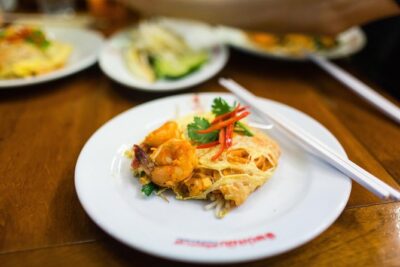
Bangkok by Night: Temples, Markets and Food Tuk-Tuk Tour
Read our review →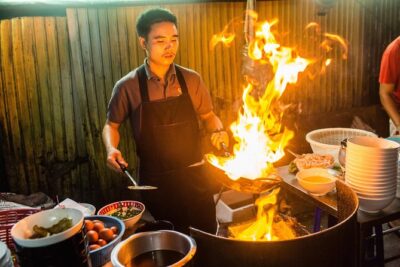
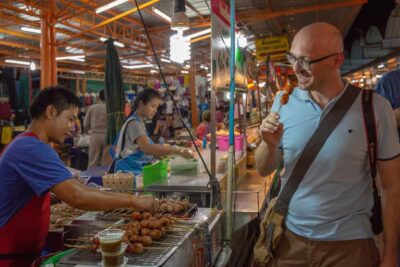
Markets, Temples and Food Night Tour by Tuk Tuk
Read our review →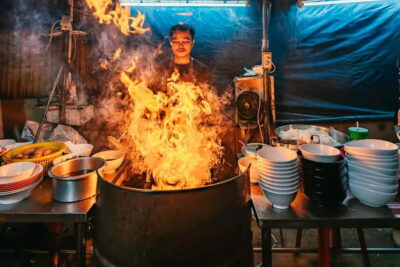
Evening Tour with Wat Arun, Wat Pho & Tuk Tuk Ride
Read our review →
Bangkok Tuk-Tuk Tour by Night with Chinatown Street Food Meal
Read our review →Browse the lists this tour appears in